The Carbon Border Adjustment Mechanism Explained
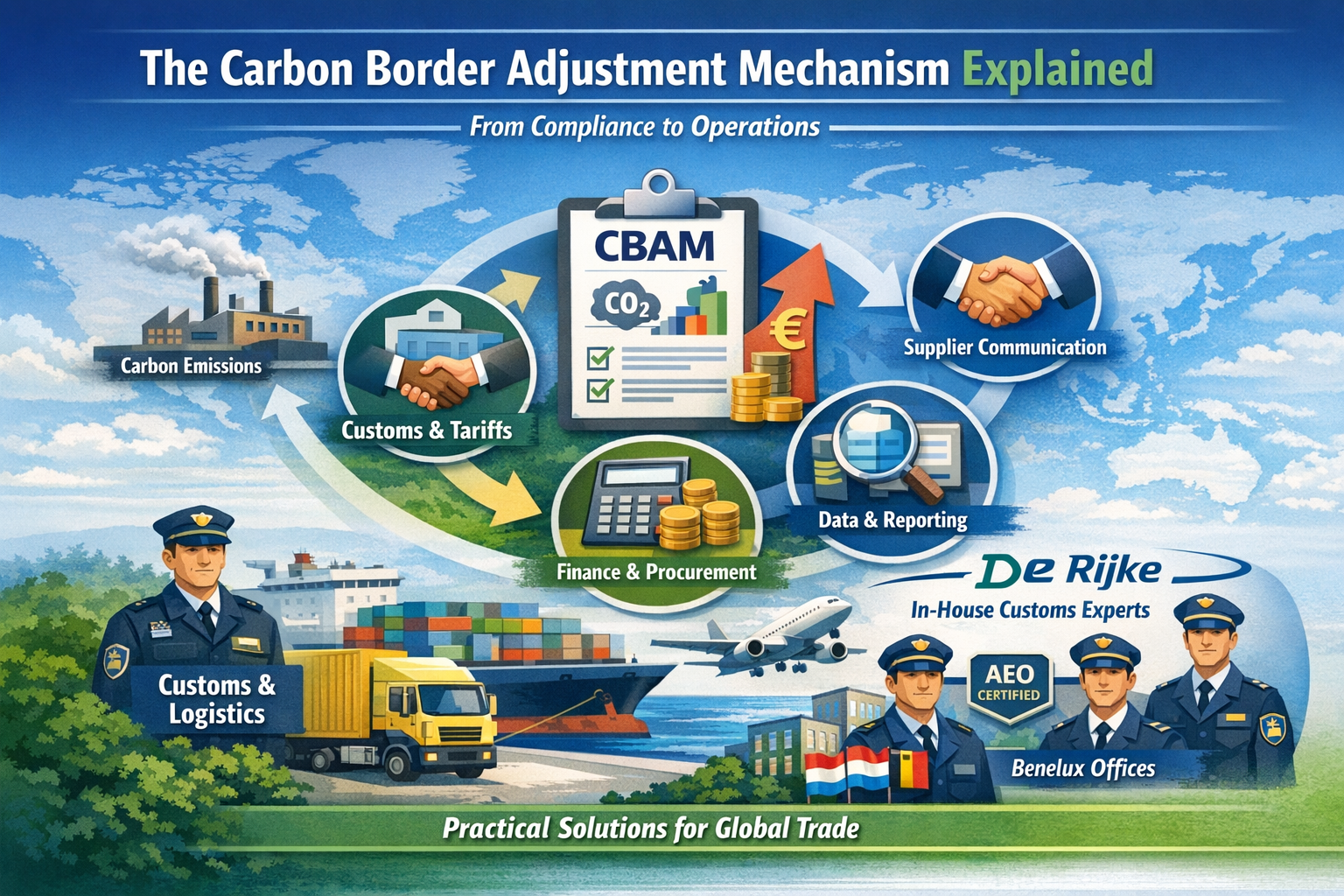
For many businesses, the challenge is not understanding the term itself. The challenge is organising the right process behind it. CBAM affects supplier communication, customs coordination, internal responsibilities and the availability of reliable data. That makes it relevant not only for sustainability teams, but also for procurement, finance, customs and logistics.
De Rijke helps companies manage international logistics and customs processes in a practical way. With in-house customs departments in the Benelux, experienced customs brokers and AEO-certified customs processes, we support customers who need control over both compliance and daily operations.



What is CBAM?
CBAM stands for Carbon Border Adjustment Mechanism.
It is the EU’s mechanism for applying a carbon-related framework to specific imported goods. The aim is to address carbon leakage by aligning the treatment of certain imports more closely with the EU’s carbon pricing approach. The European Commission describes CBAM as an environmental policy tool for fair carbon emissions pricing.
For importers, this means additional obligations linked to goods in scope. Depending on the product and customs classification, businesses may need to collect emissions data, organise reporting and make sure their import process is aligned with the applicable CBAM requirements. The Commission’s importer guidance also places strong emphasis on identifying goods in scope and understanding reporting roles and responsibilities.
Quotation
Which goods are affected?
Under the current framework, CBAM applies to goods in the following sectors:
- cement
- aluminium
- fertilisers
- iron and steel
- hydrogen
- electricity
Whether a specific shipment falls within scope depends on the product concerned and the relevant customs classification. That is why the starting point should always be practical: review your product flows, check the applicable commodity codes and identify which suppliers and shipments may be affected.
Why CBAM is an operational issue
CBAM is often seen as a reporting requirement first. In practice, it usually becomes an operational issue much earlier. The main difficulty is that importers depend on information that is not always readily available. Emissions data needs to come from suppliers. Product information needs to match customs classifications. Internal teams need to know who owns which part of the process.
That creates friction in everyday operations.
A customs entry may be ready, while supplier data is still incomplete. A procurement team may understand the source of the goods, while customs and logistics teams still need the right supporting information. Where responsibilities are spread across multiple departments or countries, the process can become fragmented very quickly. This is where a practical structure matters. CBAM works best when it is embedded into the wider import process rather than handled as a separate compliance exercise.
CBAM and customs compliance
For importers, CBAM sits close to customs. The process starts with understanding which goods are in scope and how they are classified. From there, businesses need to organise the right supporting data and make sure reporting and customs processes do not drift apart.
That matters because weak alignment creates risk. If product scope, supplier information and customs handling are not connected, businesses can lose visibility and spend more time correcting issues later. At De Rijke, customs formalities are already a key part of international transport and supply chain support. De Rijke’s customs teams handle import and export formalities, transit documents, excise goods and supporting origin documentation, while customs-related services are offered both to logistics customers and to companies that organise transport via third parties.
That broader operational view is important for CBAM as well. It is not only about submitting information. It is about making sure the full import process remains workable.
Where importers usually face complexity
Most companies affected by CBAM do not struggle with the concept alone. They struggle with execution.
Supplier data
CBAM depends on upstream information. That means importers need timely and reliable data from suppliers outside the EU. In practice, that is often where the first gaps appear.
Product scope
Not every imported product is in scope. Businesses need to assess goods carefully based on product type and customs classification.
Internal ownership
CBAM often sits between departments. Procurement, customs, finance, sustainability and logistics may all have part of the answer, while no single team owns the full process.
Process consistency
A one-off solution is rarely enough. Importers need a repeatable way to organise data, review shipments and support reporting over time.
How De Rijke supports businesses affected by CBAM
De Rijke is not a theoretical compliance partner. Our strength is in connecting customs knowledge and logistics operations. That fits the reality of CBAM. For companies importing goods into the EU, the issue is usually not a lack of awareness. It is the need for a workable process that supports day-to-day business. That process has to fit your product flows, your suppliers and your customs setup.
De Rijke supports customers with:
- customs coordination
- practical import process support
- supply chain alignment
- handling of customs formalities in-house in the Benelux
- connection between logistics execution and customs requirements
Because De Rijke also supports bonded and non-bonded storage, transit documentation and wider European customs coordination, we understand how customs requirements affect the flow of goods beyond the declaration itself.
Preparing for CBAM
The EU has now moved into the definitive CBAM phase. The Commission states that the definitive regime applies from 2026 onwards, and importers of CBAM goods are being urged to apply for authorised CBAM declarant status where relevant. The Commission has also communicated that importers will buy CBAM certificates corresponding to the applicable carbon price under the definitive period. That makes preparation more important, not less.
A good starting point is to assess which goods may fall within scope, where supplier data needs to come from and how your customs and operational processes currently fit together. Businesses that organise this early are in a stronger position to reduce disruption and maintain control.
Need support with CBAM?
If CBAM is becoming relevant to your imports, De Rijke can help you approach it in a practical way.
With customs expertise, in-house customs departments in the Benelux, AEO-certified processes and a strong connection to daily logistics operations, we help customers bring structure to complex import flows.
That way, CBAM becomes part of a manageable process rather than a separate source of uncertainty.
Get in touch

Ready to expand into Europe via Rotterdam?
Connect with our local team today. We’ll help you build a warehousing and distribution strategy tailored to your products, sector and growth plans. Contact us via derijke.com/contact or email info@derijke.com. Your European logistics partner starts here.

Frequently asked questions about CBAM
CBAM stands for Carbon Border Adjustment Mechanism. It is an EU system that applies carbon-related requirements to certain imported goods. The aim is to reduce the risk of carbon leakage and support a fairer competitive environment between goods produced inside and outside the European Union.
CBAM currently applies to selected carbon-intensive sectors, including iron and steel, aluminium, cement, fertilisers, hydrogen and electricity. Whether a specific product is covered depends on the product type and the relevant customs classification.
CBAM may apply if your company imports goods into the EU that fall within the sectors currently covered by the mechanism. The best starting point is to review your product scope, commodity codes and supplier structure to determine whether your imports are affected.
For importers, CBAM creates additional responsibilities around product scope, supplier emissions data, reporting and compliance. It can also affect internal coordination between procurement, customs, finance, sustainability and logistics teams.
CBAM is relevant for supply chains because it depends on accurate upstream data and good coordination across the import process. If supplier information, customs handling and reporting are not aligned, businesses may face delays, inefficiencies and compliance risks.
CBAM is closely connected to customs processes. Importers need to understand whether goods are in scope, how those goods are classified and how supplier information supports the wider reporting and compliance process. A clear link between customs and operational processes helps reduce risk.
Many businesses face challenges around supplier data, product scope, internal ownership and process consistency. In practice, the main difficulty is often not the regulation itself, but building a workable process that supports day-to-day imports.
De Rijke supports businesses with customs coordination, logistics operations and practical import process support. By connecting customs knowledge with supply chain execution, De Rijke helps customers create a more structured and manageable approach to CBAM-related requirements.
